Residential battery-based PV systems have been installed by certified PV Professionals for decades. With rising utility costs and system components becoming more readily available and affordable, off-grid and grid-connected backup systems have become more popular than ever.
A battery bank that is properly sized, maintained and installed in a well-designed enclosure will provide many years of service. Following guidelines and the manufacturer’s recommendations for proper design and placement of the battery enclosure, while adhering to all code requirements and necessary precautions, will ensure the system operates efficiently and safely.
Lead-acid batteries, like other battery technologies, will offer the best performance when operating temperatures are maintained at 20°C (68°F). Higher operating temperatures cause cell degradation which shortens the cycle life of the battery. Lower operating temperatures will reduce capacity.
Flooded lead-acid batteries off-gas hydrogen while charging. This includes the Bulk and Absorption phase of a 3 phase charge profile and any routine corrective equalizations. Hydrogen is explosive and may ignite if exposed to open flame or spark and is also corrosive to electronics. For this reason, active ventilation must be installed in the battery enclosure to prevent the buildup of hydrogen gas.
When operating at 20°C (68°F) ambient temperature, sealed (VRLA) batteries such as AGM or GEL models do not require active ventilation as hydrogen off-gassing during charge is minimal. However, passive airflow in the enclosure is required, at a minimum, as these batteries will off-gas small amounts of hydrogen during heavy charging. At higher ambient temperatures, ventilation also prevents overheating which accelerates cell degradation and shortens battery life.
CONSIDERATIONS:
Location:
- Review and follow all local code requirements.
- Flooded lead-acid batteries required active ventilation to remove hydrogen off gassing. Sealed VRLA batteries require passive airflow at a minimum. In an installation where ambient temperatures are greater than 25°C (77°F) active ventilation should also be installed.
- The location of a battery enclosure should always be the first consideration. The battery bank should not be installed in a living space.
- If the battery enclosure is located inside a storage room or garage, the active ventilation system must exhaust outside, away from windows, doors or fresh air intake. Please consult your local codes and standards for specific requirements as you are exhausting gasses that are potentially explosive.
- Ventilation systems must exhaust outside and may exit via a ceiling or wall-mounted vent. Wall-mounted exhaust should be as close to the ceiling height as possible.
- Fire code requires that flooded lead-acid batteries are not installed in the same room as the inverter or any other electrical device, appliance, pilot light or heating system which may pose a risk of spark or fire. Although an active ventilation system will be installed, do not install the battery enclosure directly below a wall-mounted charger
or inverter as hydrogen is corrosive and may damage this equipment.
- If the battery enclosure is on the exterior wall of a home or other structure it must not be positioned in direct sunlight to prevent overheating.
Zephyr Industries offers a variety of 12V, 24V & 48V power vent fans specifically designed for battery enclosures. These fans may be operated from the auxiliary relay on high-end charge controllers or by a voltage-controlled switch. When connected to a voltage-controlled relay, the fan operates only when the batteries are being charged and blows gas vapours out. These units also include a built-in damper when not in use to minimize back drafting.
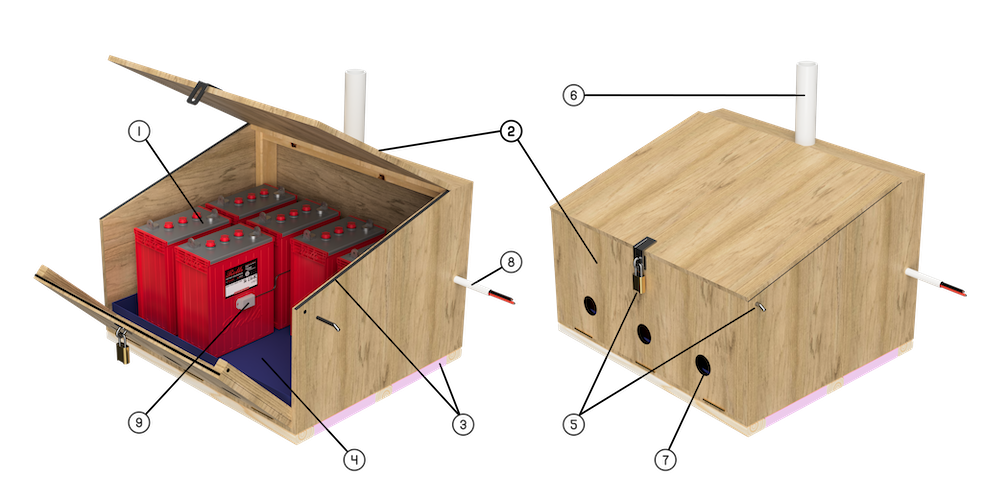
1. SIZE: When building a custom battery enclosure or purchasing a pre-built cabinet it is essential that the enclosure allows sufficient spacing around and between the batteries. Most lead-acid battery manufacturers recommend a minimum of 1”-3” spacing on each side of the battery to allow adequate cooling as the batteries heat up during charge, to allow proper airflow for removal of hydrogen off-gassing, and ease of maintenance. The height of the enclosure should also allow adequate space for easy installation/removal, routine inspection, watering and space for battery cabling.
2. DESIGN & ACCESS: Easy access to the battery bank is important as routine maintenance such as watering (flooded models) and cleaning & re-torquing terminal connections will be required. The enclosure should have a hinged slanted lid to ensure easy access and discourage placing or storing items on top of the lid. When working with larger, heavier batteries, a removable or hinged front entry is also preferred as this will allow easier access for installation & future battery replacement.
3. INSULATION: foam or rubber weather stripping should be used around all openings at the top to seal and prevent hydrogen gas from escaping the enclosure as well as preventing rodents from getting inside. Batteries will self-discharge when not in use which poses a risk of damage due to freezing in cold temperatures. If the enclosure will not be in a climatized space and the system operates in very cold temperatures, rigid foam insulation may be installed under the bottom of the enclosure and/or around the interior, as well as the space between the batteries to reduce the risk of freezing. Insulation should be removed in warmer months to prevent overheating.
4. SPILL CONTAINMENT: a spill-proof liner should be installed in the enclosure. This
will contain any electrolyte overflows due to leaks from the batteries in the case of overfilling, puncture or cracked cases from freezing.
5. SAFETY: For safety, the enclosure must include a latch and/or lock. Removable pin(s) may be used to secure the hinged front wall in place when unlocked and the lid is open.
6. VENTILATION: when using flooded lead-acid batteries the enclosure must have active ventilation. If the battery enclosure is located inside a storage room or garage, the active ventilation system must exhaust outside via a ceiling or wall-mounted vent, a minimum 2m (6.5 ft) from any opening (doors or windows) or fresh air intake. Wall-mounted exhaust should be as close to the ceiling height as possible.
7. AIR INTAKE: intake vents should be installed along the bottom 1/3 of the enclosure
to allow proper airflow when the fan is active. Installing screen or vent inserts is recommended to keep rodents out of the enclosure.
8. WIRING: use conduit to run wiring in/out of the enclosure, including battery connections and the battery temperature sensor, to protect wiring.
9. TEMPERATURE SENSOR: most charge controllers and inverters use a battery temperature sensor to regulate charge voltage. This sensor should be mounted on the side of a battery cases in the middle of battery bank, as shown.
Was this article helpful?
That’s Great!
Thank you for your feedback
Sorry! We couldn't be helpful
Thank you for your feedback
Feedback sent
We appreciate your effort and will try to fix the article