WIRING CONFIGURATION 2: OPEN LOOP ONLY BATTERY TO BATTERY WIRING
Due to the terminal current limitation of the R48-100LFP ESS model, the terminal itself can only sustain 100A continuous current. So, the following configuration can only be used in OPEN LOOP configurations. Failure to comply with this may cause heating and melting or burning of terminals and risk of irreparable damage to batteries or external fire.
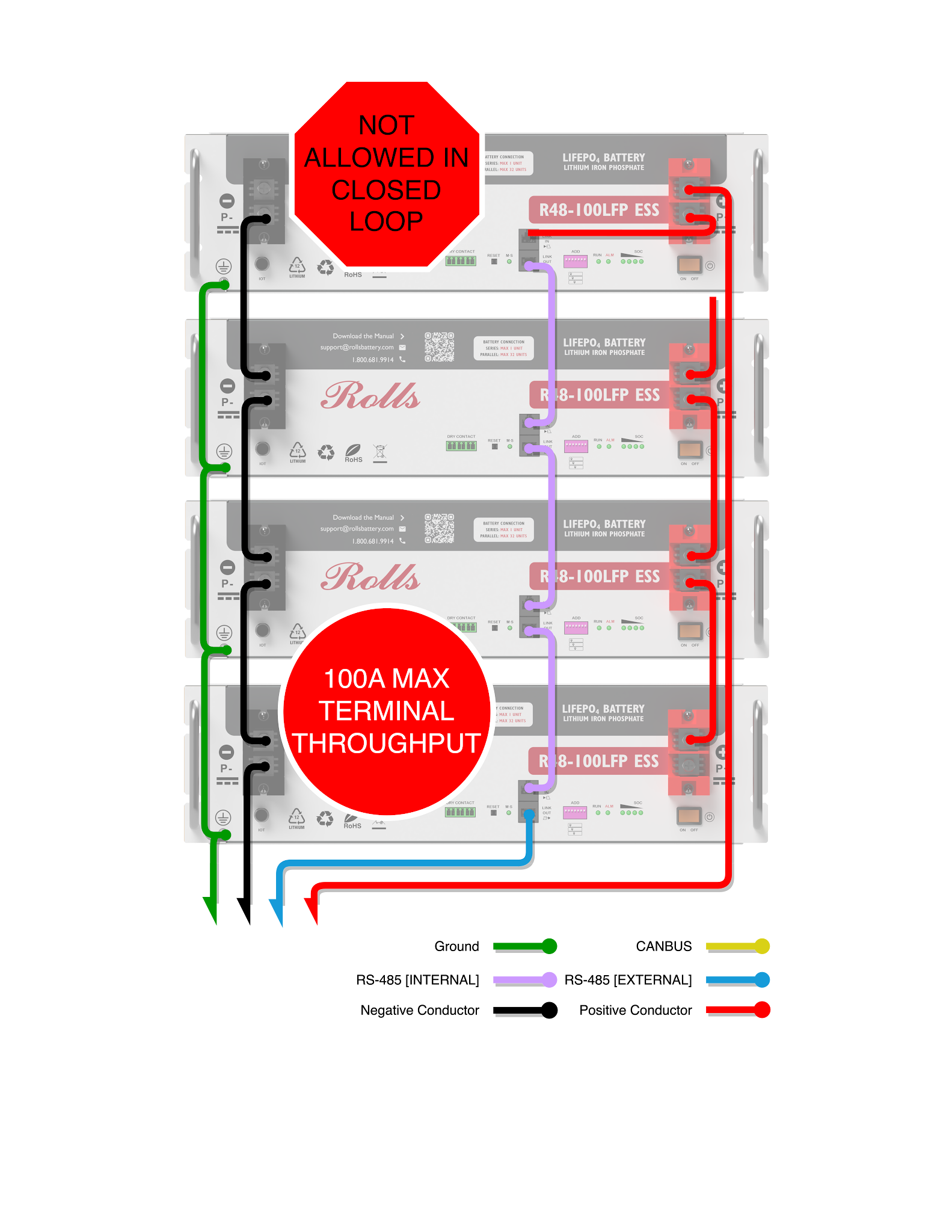
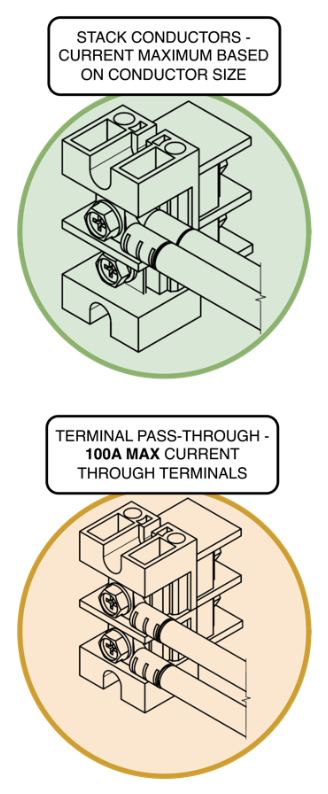
Note: On the Rolls R48-100LFP ESS, each terminal has a maximum pass-through current limit of 100A.

WARNING: Series connection of Rolls R48-100LFP ESS batteries is NOT supported. Connecting batteries in series will directly lead to BMS failure under numerous conditions, risking cell health and user safety, and will void the product warranty
PRECHARGE
The highly capacitive DC inputs/outputs of large inverters may appear to the battery as a short circuit on initial connection. To accommodate the resulting current spike during startup, there is a programmed delay and resistor connection to avoid short circuit protection on the BMS after relay engagement. Follow the commissioning procedure in the Rolls R48-100LFP ESS Battery Installation Manual. If you still have issues with startup, contact Rolls Battery Technical Support for more advanced troubleshooting tips.
BMS PROTECTION SYSTEM
Rolls R48-100LFP ESS batteries include a built-in battery management system (BMS) which offers protection in conditions where the battery voltage, current, and switch or cell temperature may be unsafe or damaging. The BMS in the R48-100LFP ESS provides protection against cell and pack overvoltage and undervoltage, charge and discharge overcurrent, high and low temperature, reverse polarity and short circuit. The switch architecture of the BMS allows charge and discharge to be stopped independently. Outside of intended operating conditions, the internal BMS will interrupt the current into or out of the battery independently, or disconnect it fully, as required.
The BMS on all R48-100LFP ESS batteries also incorporates RS-485 and CAN bus communication ports. Data communication among connected batteries is carried out through via RS-485 communication. Batteries address automatically when connected without the need to set DIP switches for each. Either the RS-485 or CAN bus output from the leader battery can be used based on the required protocol definition for the external equipment, set with the provided DIP address table.
Note: Re-charge the battery within 24h of the battery being over discharged, prolonged time in a fully discharged state may damage the cells.
Note: Manually short-circuiting or reversing the battery polarity will void the warranty.
Was this article helpful?
That’s Great!
Thank you for your feedback
Sorry! We couldn't be helpful
Thank you for your feedback
Feedback sent
We appreciate your effort and will try to fix the article