BATTERY CHARGING
A lithium-specific charger following one of our compatible closed loop interfaces is recommended for all installations. Rolls R48-100LFP ESS batteries are compatible with many common hybrid inverters, solar charge controllers, lead-acid battery chargers, and other electrical equipment designed for nominal voltage of the pack. Programming should adhere to the LFP charging requirements for the ESS models based on the specific number of Rolls R48-100LFP ESS connected in parallel.
Note: Some chargers will not allow for temperature dependant settings. If you are in doubt, or your system sits at room temperature for most of the year with some exception, the value from 17-40°C (63-104°F) may be broadly applied for good cell health.
Rolls R48-100LFP ESS batteries may be cycled or stored in a partial state-of-charge (PSOC). Under normal operation, the battery should be cycled from 0% depth of discharge (DOD) or 100% state of charge (SOC), to 80% DOD or 20% SOC for optimal cycle life. To prevent over-discharge, the BMS will disconnect the battery when the low voltage cut-off is reached, protecting the battery from over-discharge.
Note: LFP cells do not need maintenance charges like equalization, pulse charge, overcharge, or any others typically recommended or required for lead-acid batteries.
CHARGING GUIDELINES
Rolls R48-100LFP ESS batteries may be charged in a 1, 2, or 3-stage charge profile, shown below. The specifics and recommended setpoints for these charge regimes are explained in this section, with the recommended charge profile in open loop communication found via the 2-Stage Charging – CC/CV section.
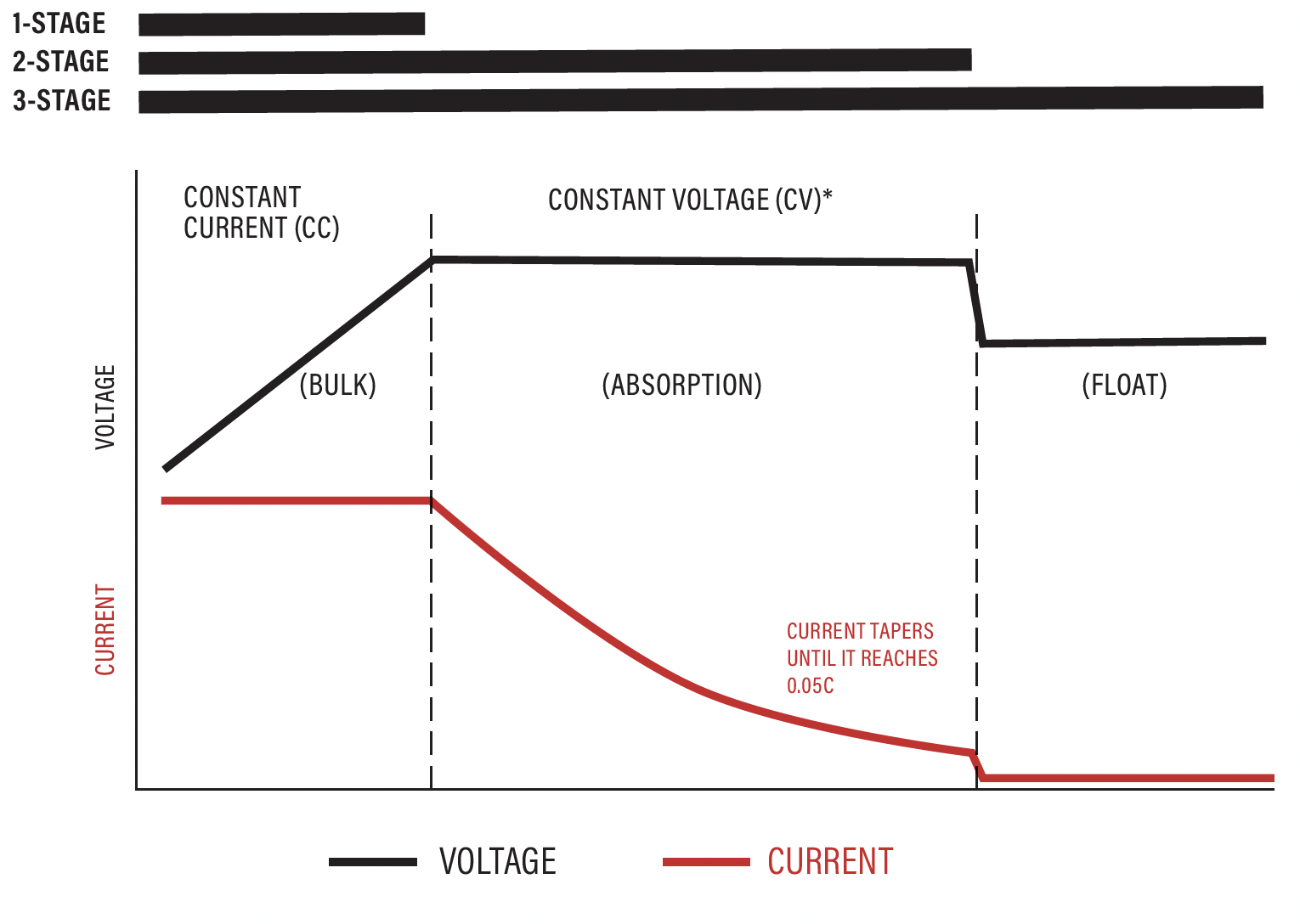
Representation of 1, 2, and 3-Stage Charging Profiles
Representation of recommended 3-stage Constant Current/Constant Voltage (CC/CV) charging. The first dotted line represents the transition from CC to CV when the voltage limit is reached. Once the battery reaches the CV limit, the battery is held by the charger at this voltage until the current decreases to 0.05C. At this point the battery is at 100% state of charge (SOC). Any current continuing to flow in the float stage is attributable to balancing activity of the BMS.
CHARGING SOURCE: LEAD ACID BATTERY CHARGER
Customers may choose to replace lead-acid batteries with lithium models. Most lead-acid battery chargers may be used to charge Rolls LFP batteries if the charger is properly configured to operate within recommended charge current and voltage limits.
The pre-programmed voltage settings for AGM or OPzV GEL models may be in line with LFP charge voltage settings and can sometimes be used if direct voltage control is not possible for your charger. However, flooded lead-acid batteries often require higher charge voltage settings. If left configured for charging flooded batteries, the higher charge voltage can trigger the BMS to restrict charging to protect the battery, effectively resulting in a 1-stage charge. If this occurs repeatedly, or the charger cannot be configured at a lower charge voltage, it may be necessary to replace the charger.
1-STAGE CHARGING – CC
When charging with a single-stage CC (constant current) charger, charge at the recommended charge current until the battery reaches its termination voltage.
Note: 1-Stage CC Charging may be required if charging from a source which is not efficient to run at lower power. However, it may only charge the battery to 90-95% SOC and offers minimal balancing time for the BMS. For these reasons, 2-Stage CC/CV charging is recommended to ensure the battery reaches full SOC.
2-STAGE CHARGING – CC/CV
When charging with a two-stage CC/CV (constant current/constant voltage) charger, charge at the recommended charge current, by operating temperature, until the battery reaches the “absorption” voltage or constant voltage (CV) limit. The charger then holds the battery at CV until the charge current decreases to ≤0.05C (termination current). It is recommended to increase absorption time based on parallel batteries consistent with the table below.
The recommended absorption (CV) voltage is shown below. If the charger has a pre-set voltage setting or cannot be programmed, an absorption voltage in the range below is also acceptable.
Note: lower voltage will lead to longer charge times but will also improve balancing performance.
Absorption Timer: When manually setting charger settings, a proper Absorption Timer is critical to enable balancing of the parallel batteries and maintaining overall system capacity. Setting the time at 20-30 mins per parallel string is recommended when Absorption is based on a timer.
Note: If limited charge time is not a concern within your system architecture, reducing the Absorption voltage will increase charge time and allow the BMS more time to ensure cells remain balanced. As batteries age, variances may become more apparent due to small changes in manufacturing or uneven wear, requiring more time to maintain cell balance.
3-STAGE CHARGING - LEGACY LEAD-ACID SYSTEMS, INVERTER/CHARGER HARDWARE
When programming an inverter/charger or charge controller equipment using a 3-stage charge sequence (2-stage with an additional “Float Voltage” after the charge is terminated), the following charging parameters should be programmed to properly charge Rolls R48-100LFP ESS batteries:
Absorption Timer: When manually setting charger settings, a proper Absorption Timer is critical to enable balancing of the parallel batteries and maintaining overall system capacity. Setting the time at 20-30 mins per parallel string is recommended when Absorption is based on a timer.
Temperature Compensation: If the inverter/charger or charge controller uses Temperature Compensation this should be turned off when charging Rolls R48-100LFP ESS batteries. Turn off the Temperature Compensation settings and disconnect the sensor to ensure the correct voltage regulation from the charging device.
Equalization: Equalization should never be used; elevated charge voltages are unacceptable for LFP batteries and will lead to the BMS disconnecting the charging path. It should be turned off, or the Equalization Voltage setpoint should be reduced to the appropriate system Float Voltage, above.
Some charger models may require additional firmware, programming, or parameters. Please contact your inverter/charger or charge controller manufacturer for assistance with these settings, if required.
CHARGING TEMPERATURE
Due to the chemistry of Lithium-ion cells, these batteries cannot accept high charge current at lower operating temperatures without risking cell damage and permanent loss of capacity.
Rolls R48-100LFP ESS batteries may be safely charged between 0°C to 55°C (32°F to 131°F). However, because cycle wear is accelerated below 10°C (50 °F), charge current should be limited to 0.2C (20% of battery capacity). for optimal longevity. Similarly, at high temperatures, charge current should be limited to ≤0.2C when operating at temperatures from 35°C to 55°C (95°F to 131°F) as noted below.
To maintain optimum performance and durability of Rolls R48-100LFP ESS batteries, the following recommended charge current limits should be followed and set at the inverter or charger, where available:
Note: Due to the internal chemistry, R48-100LFP ESS batteries may be discharged at ambient temperatures as low as -20°C (-4°F). However, they cannot be charged at the same temperature. At temperatures between -20°C (-4°F) and 0°C (32°F), batteries can still deliver energy. However, they cannot be charged, as the ambient temperature must be above 0°C (32°F) to enable charging. At temperatures between -20°C (-4°F) and 0°C (32°F), energy may be consistently removed from the battery without being replenished as expected, which may lead to full discharge.
Was this article helpful?
That’s Great!
Thank you for your feedback
Sorry! We couldn't be helpful
Thank you for your feedback
Feedback sent
We appreciate your effort and will try to fix the article